
Mythological

Mandhata or Mandhatri – the King of the Ikshvaku dynasty

Have you ever heard people saying “made at the time of Mandhata” about a very old item? Who or what Mandhata was? Let me tell you that he was a powerful king found mentioned in Hindu epic Ramayana, who ruled the world long ago.

In Satya Yuga, with the onset of human civilization, in there was a king named Yuvanshva who ruled the kingdom of Ayodha. He was a ruler of Sun-Ikshvaku Dynasty. Yuvanshva had no kids, hence no heir to his throne. He was perturbed.

One day while he was hunting in the forest in afternoon, he became very tired and extreme thirsty. As he was exhausted, he was in search of water. After a long search, the king noticed a hermitage of some sage. King Yuvanshva entered the hermitage which was empty. There, he noticed a pot and to his great pleasure the pot was full of water. The King was so thirsty that he began to drink the water without any hesitation. As soon as he finished drinking the entire water, the great sage Vrigu entered the hermitage along with his disciples.

Vrigu was startled to see the King there and wanted to know the reason of his visiting the hermit. The King narrated the backdrop. After listening to the king carefully, Vrigu told the water kept in the pot was enchanted, just to hand over the same to his wife Matinara so that she could give birth to a child. However, as destiny made king drink the enchanted water, the king would give birth to a son.

In course of time and to the utter surprise of all, king became pregnant. With the help of Sages and God Indra, the baby boy was delivered by cutting the left side of king’s abdomen. As the king was not able to breastfeed the boy, Lord Indra arranged divine milk from heaven. Drinking that divine milk, the baby became very healthy and strong. Within twelve days of his birth he became adult. He was named Mandhata or Mandhatri. He learnt Veda and war technics in a short while.

Mandhata had divine power and could acquire an impenetrable armour, a quiver with a boundless supply of arrows and a bow named ‘Azagava, which originally belonged to Lord Siva. He became so full of strength that he also fought with Ravana and the latter being defeated by him begged apologies and made treaty with him. Mandhata conquered the entire Earth within one day. He also conquered Patallok (Hell) and almost half of the Swargalok (Heaven). He defeated kings namely Asita, Suna, Sudhanwan, Marutta, Brihadhrata, Janmejaye and many others.

He had immense will power and could control the natural phenomenon like rain, hail, thunder, and storm. He was pious and distributed alms to the Brahmins. His kingdom was full of riches. He waived taxes from his subjects.

Mandhata married the daughter of Shashabindu, king of Yadavas. They had three sons and fifty daughters. In his reign, King Mandhata performed hundred Ashwamedha Yagnas and a hundred Rajasuya Yagnas. Susandhi the eldest son of Mandhata succeeded him. Susandhi the eldest son of Mandhata succeeded him.

At the old age Mandhata, due to his continuous success, became very proud of his success and strength and intended to capture the entire Swargalok. Indra, the King of Swargalok, was worried and played a trick. He convinced Mandhata to attack the kingdom of Lavanasur, a demon who had a special trident, which was gifted to his father by Lord Siva. He and his soldiers were defeated and were turned into ash by Lavanasur. Later, Shatrughna, a descendent of Mandhata killed Lavanasur.

I am sure, you loved to know about Mandhata. Please let us know your interests and do share your thoughts.
Email us at contactareaderscorner@gmail.com
Spiritual

A brief introduction to the Upanishads

Veda is ‘knowledge’ and was originally known as ‘Shruti’ as the sages passed on their knowledge verbally to the disciples and there were no written scripts. The conclusive part of Veda are the Upanishads. They are also known as Vedanta. Veda consists of two parts, one being the Karma Kanda (ritual or action) and the other the Jnana Kanda (knowledge).

Brahmanas, Aranyakas and Upanishads are branches of Samhita.

Upanishads discuss about knowledge and philosophical concepts. It is taught at the end of the Vedas as it speaks about the ultimate knowledge, the Moksha or enlightenment. Upanishad is derived from the Sanskrit root words Upa and Ni. Upa means ‘nearness’ and Ni denote ‘totality’. Hence, Upanishad means sitting closely with the Guru or teacher to get the complete supreme knowledge or Brahmavidya from him.

What is World? Who am I? What is after death? These questions have been discussed and answered in Upanishad. Its prime theme is nature and God. The doctrine of the true knowledge of nature and the concept of one God are the ultimate philosophies behind Upanishad.

There are four Vedas which are as below

  • Rig veda
  • Sam veda
  • Yajur veda
  • Atharva veda

Upanishads are associated with four Vedas and clarified their visions elaborately.

There are large number of Upanishads (almost 200) and mostly 13 of them, included in the four vedas are as follows:

  • Aitareya Upanishad
  • Isha Upanishad
  • Maitri Upanishad
  • Chandogya Upanishad
  • Kena Upanishad
  • Mundaka Upanishad
  • Mandukya Upanishad
  • Kaushitaki Upanishad
  • Brihadyaranyak Upanishad
  • Taittiriya Upanishad
  • Svetasvatara Upanishad
  • Katha Upanishad
  • Prashna Upanishad

Though the philosophy of all of them are same yet each Upanishad has its own original thinking and specific ways of enquiry. The Vedic sages gave the solution to source of Life and Liberation. According to the Upanishads, Atman and Brahman when connected through following the Supreme power, gives the path to liberation or moksha. Upanishads were considered the secret teachings. Gayatri Mantra from the Vedas found importance in relation to meditation and prayers. Upanishad plays a prime role in the evolution of the concepts of Indian philosophy.

It is difficult to understand the Indian Sanatan Dharma and the rich Indian culture without an intense knowledge of the Vedas and the Upanishads.

Hope you loved reading. I will try to share more concepts on the Upanishads in future.
Please let us know if you want to share your thoughts.
Email at: contactareaderscorner@gmail.com
Stay in touch.

Namaste.

Mythological · Short Stories · Spiritual · Stories

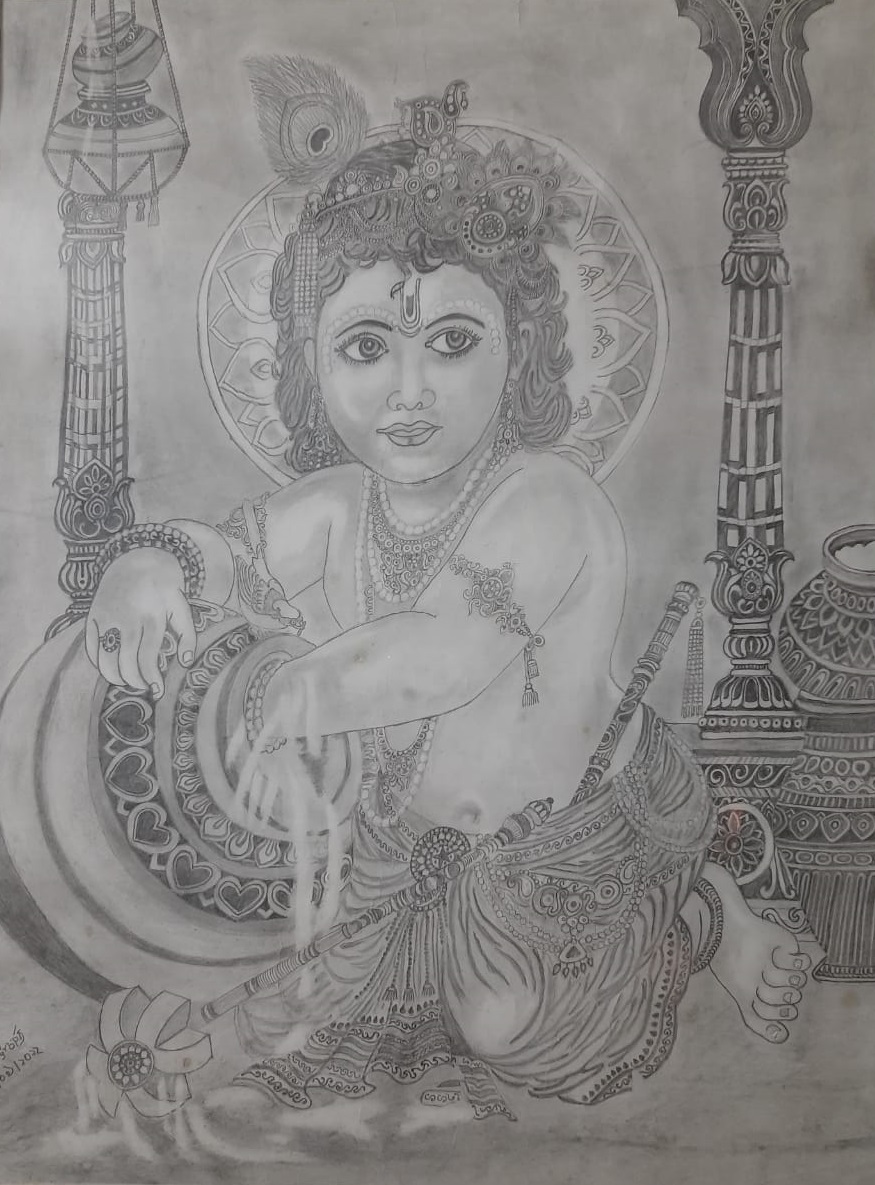
Janmashtami and the birth story of Lord Sri Krishna

Gopal Sri Krishna Janmashtami
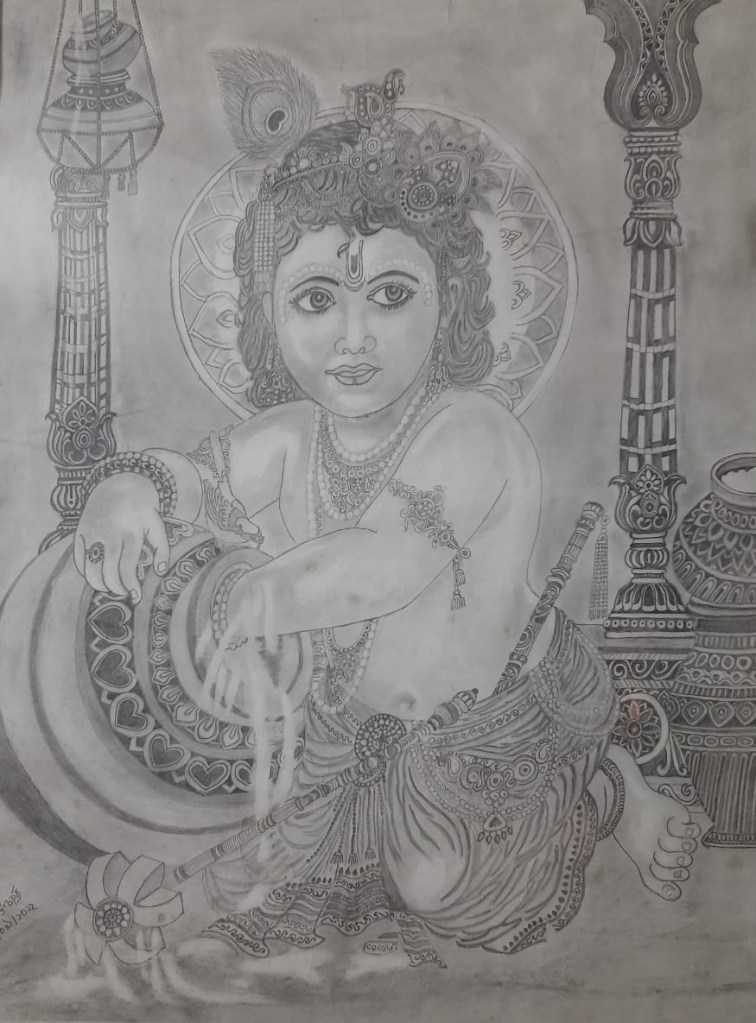
Gopal Sri Krishna – Sketched by Chanchal Chandra Bhattacharyya

Janmashtami is a major festival of the Hindus. It is celebrated all over the world to commemorate the birth of Lord Krishna, who was the eighth incarnation of Lord Vishnu, the principle God of the Hindus. Janmashtami is also known as ‘Gokulastami’ and is celebrated on the eighth day of Bhadrapada.
Krishna was the son of Vasudeva and Devaki. Vasudeva was the king of Yadav clan. Kansa, a tyrant, and the maternal uncle of Krishna was very cruel and along with other such cruel Demon kings, was terrorizing on the earth. Kansa was the brother of Devaki, who removed his father Ugrasen from the throne of Mathura, imprisoned him and occupied the throne.

Devaki, was married to Vasudeva as Kansa wanted to take over the control on Yadav destiny. After marriage when Kansa was escorting the newly married couple, Devaki, and Vasudeva to the kingdom of the Yadav, he heard an announcement made from the Heavens, that the eighth child of Devaki will end his life. Kansa on hearing the forecast became furious and plunged to de head Devaki with his sword. Vasudeva begged his wife’s life and assured that he will hand over every child soon after their birth. Hearing this promise, Kansa did not kill his sister but imprisoned the couple, so that he could smash each of their new-born child to death in the prison.

However, all the seven children of Devaki were killed by Kansa one by one. On birth of the eighth child the prison surprisingly started glowing with bright heavenly light and at the same time Vasudeva was woken with a divine voice and was advised to shift the child to the house of Nandaraja, the king of Gopa tribe (cowherds) and a bosom friend of Vasudeva.

All the guards of the prison were made fast asleep, the doors started opening one by one, as Vasudeva proceeded with the Divine child. The night was stormy, complimented with thunder and heavy rain. Vasudeva crossed the Yamuna river with the help of Sheshnag, the giant multi headed snake of Lord Vishnu.

Vasudeva reached the house of Nandaraja who was waiting for him. They entered the room where Yashoda the wife of Nandaraja was lying with her newly born girl child. Vasudeva kept his child beside Yashoda, in exchange of her girl child and returned back to the prison .Vasudeva narrated everything to Devaki .As soon as he handed over Nandaraja’s daughter to Devaki, the little one began to cry loudly . The cry woke the guards up and they immediately informed Kansa about the birth of the eighth one.

Kansa reached the prison sharply and snatched the child. Devaki prayed Kansa not to end the life of the child as the child was a female one and in no way, she could make any harm to Kansa. Kansa did not pay heed to her request and threw the baby to smash against the wall of the prison room. The child with a smile said, “I am Goddess Durga. I can destroy you instantly but will not do the same as your time of death has not yet come.” saying this she disappeared.
Child Krishna became the center of love in Gokul as he was loved and cared by all. His foster parents Nandaraja and Yashoda, and every villager and his friends loved him for his intelligence and courage. Krishna became the hero of all residents of Gokul as he was a sweet one.

In course of time he killed his maternal uncle and saved Mathura from the terrible rule of Kansa. The festival, Janmashtami is so named as lord Krishna was born on Ashtami (the eighth day of Bhadrapada) and he was the eighth child of his mother. Lord Krishna was the icon of love and bravery. Krishna Janmashtami is celebrated all over India mainly in north India especially In Mathura and Vrindavan. Krishna followers today are spread all over the world and they spread his message of love, courage, and purity of soul. On the great Janmashtami festival, the Krishna Temples across the world are decorated with colorful balloons, garlands, and festoons. The puja on Janmashtami starts at midnight as it is popularly known that Sri Krishna was born in mid night.

Devotees remain on fasting for the entire day. They offer laddu and other sweet items along with flowers, dresses, and ornaments as a part of their worship. On this day, Lord is generally worshipped in his baby form and his idol is placed on a cradle.

A special ‘Dahi Handi’ program is held as the lord was a lover of milk products, especially ‘makhana’ (butter). On the day of the festival, colorful pictures are displayed on the bravery and love of Lord Krishna.
To the Hindus and Vaishnavas, Lord Krishna is the icon of bravery. He is the closest friend and the savior God.
Hope you loved to know about Janmashtami and the story of the Lord and would like to know more about him.

To share your thoughts, please email us at contactareaderscorner@gmail.com

Motivational

How to sleep better without medication?

Are you lacking a good sleep at night?

If yes, then here are some suggestions for you, that may help overcome the problem.

In present days, especially in the lockdown period most of us irrespective of our age, are suffering from serious problems like mental anxiety or stress and an absence of sound sleep.

Take Doctor’s advice if this is creating a serious hindrance in your day to day life but try being confident to follow some basic disciplines that will  keep yourself mentally and physically fit and help you lead a better life and get a good night’s sleep.

I have passed through such difficult phase and after a long period of regular visits to the Doctor, I finally decided to practice a healthy daily routine to overcome the unhealthy situation. I got benefitted and have recovered.

Believe me the following are proven ways to get rid of anxiety and get a deep sleep at night.

  • Remain alert in your daily life, focus on every work you do, be attentive to what others say and speak your heart out in few words.
  • Always practice positive thoughts. This will help decrease your mental stress. Just throw away the disturbing negative thoughts and accept what you have or what you are going through to remain spiritually inclined and happy.
  • Practice going for a walk at least for half an hour in early morning or in the evening, that will keep you physically as well mentally fit.
  • Drink plenty of water, at least three litres a day to remove toxins from the body.
  • Eat plenty of fruits and green vegetables, less spicy food but tasty one. This will keep you fit and maintain a good hormonal balance with necessary supply of vitamins and nutrients.
  • Practice yoga and pranayama at least twice a day half an hour each time.
  • Read all types of good books.
  • Do not forget to practice what you are passionate about like enjoying a hobby like drawing, dancing, writing, crafting, any kind of sports to name a few.
  • Learn try and do one new activity a day.
  • Engage with kids in home or in neighborhood. This is a good one!!
  • Practice good manners – speaking the truth always and being honest and generous makes us bold.
  • Purifying ourselves mentally and maintaining hygiene makes us mentally and physically strong. Try to forgive yourself and others.
  • Exchange positive thoughts with others.
  • Be kind to all and help physically/ mentally / financially to at least one person every day.
  • Wash your hands and legs before you go to bed.
  • Listen to good music before going to bed.
  • Sleep in a posture that you are most comfortable with unless you have a strict restriction guided by a medical practitioner.

Above all, if you believe in God, have faith on the Almighty and if you do not believe in him remember to have faith in yourself or anybody close to you.

I assure you will get a better sleep. These are the ways that will improve your quality of life. Do not hesitate to take the Doctor’s advice to remain mentally and physically fit as it is the best way.

Want to know more? To share your ideas please contact us at email: contactareaderscorner@gmail.com

Spiritual

Sanatan Dharma explained through Bhagwat Gita

Are you a truth seeker?

Do you want to know what Sanatan Dharma is and how it evolved?

Sanatan Dharma is the oldest religion on earth, and all other religions which are prevailing now, are converted form of the same. It believes in worshiping icons (Pratima). Principle deities were Indra, Surya (Sun), Varun, Religion based on Veda was formulated by God Narayana who created Brahma. Brahma is said to be the Father of this universe. After formulation of Veda, that was first narrated to Surya and Surya told it to his son Manu and Manu made all these living beings. According to this religion, puja, prayer, yagna, were made to Agni, Varun, Indra, seeking personal gain like Son, Wealth, Kingdom, Victory, heaven and so on.

It was about five thousand years back, Lord Vasudeva Krishna explained Bhagwat Gita to his devotees and intimate friend Arjuna In the Great War field of Kurukshetra of Mahabharata. When Arjuna, the third Pandava gave up his weapons expressing his denial to war with relatives, friends, for the sake  of kingdom, Sri Krishna told it was his duty to fight against the Kaurava to establish religion-based kingdom, which is a must for one kshatriya otherwise he will deviate from his duty, which is unfair.

Krishna further said on the Kurukshetra battlefield to Arjuna, “If you do your duty properly you will deserve to settle in Heaven without having further birth. You must do your duty without seeking any personal gain. Remember in this war you are not killing any one as these all are pre-settled. Man is mortal, ours on earth is merely old body. After death there will be rebirth of this body having a new formation, and the soul with the body is immortal and it cannot be destroyed. Hence, none can kill the soul. As there is no birth and death of the soul, it exists till it returns to Almighty God. Look at me, I am the Almighty God, creator of each and everything in this Universe… I have no birth no death. I have already decided the fate of this war and all the persons who ought to die in this war, I have already killed them.

Those who work with no expectation, in the name of God, giving the result to God, and not for personal gain and for others only, he is my actual devotee. I will protect him from all the adverse results. After death he will get no further birth.”

Arjuna was satisfied with the advice and prepared to war with Kaurava.

Lord Krishna in this way opposed the concept of Veda in worshiping for personal gain/expectations. In Bhagwat Gita he advised to do work without any expectation and encouraged to work in the name of God.

The name of Hinduism started in early nineteenth century.

Poems

Our worship

Try your best and look what you can do
We are blessed by God, he is with us,

Go ahead and achieve your goal
Almighty will be happy with us,

Our work is our worship to God,
Go and worship with your work.