Kids Stories · Motivational · Mythological · Short Stories · Stories

Chetak, the Blue horse

By Kritadhi Chakraborty

“Ho! Rider of the blue horse!” a familiar voice made Maharana Pratap look back. He could see only one horseman amidst the yellow dust… his brother Shakti Singh. But the sound of hoofs against the flinty rocks superseded his emotions as his savior today, none other than his beloved stallion Chetak, blazed through the mountains of Haldighati. Chetak, like his master Rana, was heavily wounded. “Hey Devi Ma!” uttered Maharana when for a few seconds (as though) time came to a standstill… Chetak was about to take a breathtaking leap over a mountain stream. As if the strength of a 100 horses has been bestowed upon him. Nobility unimaginable, will power to rescue his master whom he had borne through the day. Chetak fell along with Rana. Within a few moments Rana was back on his feet to fight back – but was relieved to find that none of his pursuers dared cross the stream.

Pratap rushed to Chetak… quickly unbuckled the harness. “Chetak! Chetak!” Rana’s voice choked in admiration of his valiant stallion as he realized that it was time to part with his guardian angel. Chetak’s expressive eyes, despite the blood dripping over it, was beaming with success and joy.

Rana took Chetak’s long face on his lap and cuddled the peacock shaped neck… far from Rakt Talai (the battlefield), Rana could only hear the breeze over his shoulders… as he recollected the happenings of the day.

The Mughal Sultan Jalal Uddin Muhammad Akbar was on his way to take Udaipur, located at the heart of Mewar. The Mewari army consisting of 20,000 soldiers were up against 80,000 Mughal troops. Maharana Pratap was holding the flower (flag) of Mewar. The Mewari army fought gallantly beside their prince who led the banner into the hottest part of the field. Rana had disguised Chetak as an elephant by putting an armor in the shape of an elephant’s trunk. Chetak charged an elephant by raising one leg upon the elephant’s trunk, giving a chance to Pratap to throw his lance at the enemy. The mahout got killed instead. In the process, the elephant’s tusk tore through Chetak’s leg and crippled him. Rana was wounded too. The battle was slowing turning into the favor of the Mughals as they rallied near Rakt Talai. The Mewari forces, that were left, had to make a tactical fall back. A camouflage had to be created to give Maharana Pratap enough time retreat.

It is said that Chetak, with a mind of his own, only submitted to the Maharana; and that he was the one to choose the king, not the other way around. Critically injured Chetak refused to succumb to the pain and only on three legs helped his master flee from the battlefield, to live to fight back again.

Chetak passed away in the arms of his master Maharana Pratap.

We don’t know how much of this is real. History does not name the horse ridden by Maharana Pratap at the Battle of Haldighati on 18th June 1576, nor do they attribute any unusual feat or achievement to it. The story is recounted in court poems of Mewar from 17th century onwards. Whatever the reality may be, what is important here is that the story inspires millions of Indians over hundreds of years. This story about the nobility and valiance of an animal inspires me.
Motivational · Mythological · Spiritual

Devi Bhairavi

Devi Bhairavi is the fifth great power of Das Mahavidya and is one of the supreme controllers of the eternal cosmic function of this universe.

Devi Bhairavi is a fierce and popular Goddess and is the Goddess of Decay. Bhairavi means ’Terrifying’. Mata Bhairavi is also known as Tripura Bhairavi and her consort is Bhairav the fierce form of Lord Siva. Devi Bhairavi is the supreme terror of the three worlds- Swarga, Martya, Patal. According to Parasurama’s ‘Kalpasutra’, the name Bhairavi is originated from the combination of three root words – ‘bha’,‘ra’ ,‘va’. In this ‘bha’ means preservation, ‘ra’ denotes Ramana means divine activities of creation, ‘va’ derived from Vamana means relaxation in certain activities.

Devi Bhairavi has many qualities like Goddess Kali. She is the Goddess of transformation, and the power connected to destruction of evil forces.

She is the goddess of destruction. Destruction here is not considered a negative force, but essential to maintain continuity in the great cycle of death and birth in the world. Mata Bhairavi is also popularly known as ‘Tripura Bhairavi’ where ‘tri ’means three, ‘pura’ means castles and cities. Hence Tripura Bhairavi indicates three levels of consciousness active-dream-sleep.

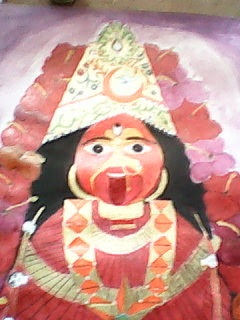
Mata Bhairavi in images and idols are found to be seated on a Lotus with four hands- with book in one hand, rosary bead in another, in another one Abhaya mudra and in the other hand displaying Varada mudra. She is wearing red clothes and a garland of severed heads on her neck. She has three eyes (Trinayan) and a crescent moon on her crown. In tantric form of the Devi, we find her sitting on Lord Siva, her one hand with a sword and a cup of blood in another one, her other two hands are with Abhaya and Varada mudras, respectively.

It is stated that Devi Tripura Bhairavi resides in Muladhar Chakra, and her mantra consists of three alphabets (letter) forming an inverted triangle in the centre of Muladhar chakra as ‘kamrupa’, representing the Universe. Devi Bhairavi is the creator of this Muladhar Chakra.

In Tantra, a female adept in Kundalini system is also known as Bhairavi, yogini. Sometimes she prefers to be with her Bhairav, the male partner, at the time of meditation and devotion, called yoga. In Tantra, Bhairavi has been defined as the divine queen closely associated with Devi Rajarajeswari or Tripura Sundari. Hope you loved reading. To share your thoughts, please email at contactareaderscorner@gmail.com

Motivational · Mythological · Spiritual · Stories

Devi Bhuvaneshwari

Devi Bhuvaneshwari Is the fourth Shakti form of the Das Mahavidya after Kali, Tara and Shodashi. She is also known as Adi Shakti Parvati or Parashakti.  Mahadev Tryambak is her consort. The name Bhuvaneshwari is originated of the two words Bhuvana (universe/world) and Ishwari (Goddess/Devi/ protector/Queen) that means Queen of the World or Queen of the Universe. She is the Mother of the Earth, the Atmosphere, and the Heavens.

Based on legend, all the three regions earth, atmosphere, and heavens, are created by Devi Bhuvaneshwari. After creation of world Maa Bhuvaneshwari made all the living creatures. She has given them eternal shape. To maintain and nourish her creations, she created Brahma, Vishnu, and Rudra. There after she distributed her energy and supreme power, and as Saraswati joined Brahma, as Laxmi partnered Vishnu, and as Kali partnered Rudra, These three devas were entitled the task to create, to sustain and protect, and to destroy respectively.

Brahma with the help of Devi Saraswati has created all living beings. Vishnu with Laxmi is engaged to sustain a portion of the creation and Rudra with Kali is in a process to annihilate other portion of the creation to maintain balance in the universe. Thus, there is a continuous cycle of birth and death.

Devi Bhuvaneshwari and Mahadev Bhuvaneshwar in images and idols are found seated on Panchapretashana where Sadashiva, Ishwar, Vishnu, Rudra, and Brahma are shown as five legs and several yoginis are seen busy in serving them.

Goddess Bhuvaneshwari controls this universe. She is the Almighty. She considers all the living beings as her children and protects them always. She loves each of her creation and is a part of every creature. She fulfils the desire of every individual coming to her refuge.

Devi Bhuvaneshwari is red complexioned and three eyed (Trinayan). She has four hands, has braided hair, and found wearing red ornaments. As weapon she holds a goad and a noose in left hands, in right hands she is with Abhaya and Baroda. She is ornamented with crescent moon on her head.

Please email at contactareaderscorner@gmail.com

Motivational · Mythological · Spiritual · Stories

Devi Shodashi

In Hinduism, Devi Shodashi, also known as Tripura Sundari, is the third form of power among the Das Mahavidya after Goddess Kali and Goddess Tara. The word ‘Tripura’ in Sanskrit is combination of two words ‘tri’ or traya meaning three and ‘pura’ means city. Tripura thus refers to three cities built of gold, silver, and iron in the sky, air and earth by Maya and burnt by Shiva. Goddess Shodashi is also popularly known as Lalita (‘she who plays) and Rajarajeswari (‘Queen of the Queens’). She is also worshipped as Shri Yantra.

Goddess Shodashi is the most beautiful form in the three worlds (swargaloka, bhuloka and patalaloka). In Mahavidya she is defined as Goddess Parvati and as Tantric Parvati. Mata Shodashi is worshipped in the form of a sixteen-year-old girl and is believed that she fulfils sixteen types of desire of her devotees. She is worshiped by chanting a mantra of sixteen syllables. It is said that she has the collective powers of Brahma, Vishnu, and Rudra expressed as Brahmani, Vaishnabi And Rudrani. She has the charm of Goddess Durga and determination of Goddess Kali.

A devotee who completely surrenders to mother Shodashi is always blessed beyond expectation by the mother. The divine Mother appears calm and looks bold and charming as an innocent and a sweet sixteen-year-old girl and she is dressed in bright red costume and ornaments. Goddess Shodashi is the Goddess of love and family welfare.

Goddess Shodashi is red or golden complexioned and seated on a lotus placed on a golden throne. The idols and images of Maa Shodashi, is found to appear on a lotus on supine body of Lord Shiva lying in a peaceful position on a plank which is upheld by Brahma, Vishnu, Rudra, Ishana and Sadashiva. Goddess Shodashi has a third eye on her forehead. Her four hands carry a noose, a goad, a sugarcane as a bow, and five arrows in each, respectively. Here, noose represents attachment or to bind, goad represents repulsion or to drive away, bow indicates mind and desires, and arrows indicates five senses.

In connection to Goddess Shodashi there is a beautiful story. Once Lord Shiva referred his consort as Kali by name, in the presence of some beautiful and fair complexioned Apsaras of Heaven. Kali means black and unattractive. Goddess Kali was shocked and angered at Lord Shiva’s behaviour and felt disappointed with her own dark complexion. Feeling insulted she left Shiva and started meditation to get rid of her black complexion at an unknown place. When Devarshi Narad visited Lord Shiva he found the Lord alone. When he got to know from Lord Shiva about Goddess Kali’s exit, then Narad being a great sage could locate the Devi through meditation. Lord Brahma, by that time, being pleased with her meditation granted Lord Kali a boon to be fair complexioned. Devarshi Narad met Goddess Kali in the north of Sumeru Parvat and requested her to go back home. He played a trick and told her that Lord Siva had decided to marry someone else. Goddess Kali, however, was not aware that her complexion was changed.

Goddess Kali returned Kailash, the abode of Lord Siva. She could see the image of a fair complexioned beautiful young girl in his heart. The Devi did not realize that it was the reflexion of the Devi herself and this enraged her.

Lord Siva smiled and told her to look back at the image. At this she could realize that it was the reflection of herself. Her happiness knew no bound. She felt overjoyed to see her new look. Lord Siva named her ‘Shodashi’ respecting her new appearance and announced that Goddess Shodashi would be worshipped by all the three worlds with devotion.

Hope you loved the story. This is just a narration based on legend and I would prefer to derive from the story that outward appearance has nothing to do in our life. When through meditation and through spiritual practices, our mind comes to control, we get rid of all the disappointments and anger and we calm down, get determined, become strong internally and feel uplifted. This however reflects on our face and gives a positive appearance.

Let the blessings of the Devi enrich your life. To share your thoughts please email us at contactareaderscorner@gmail.com

Mythological · Spiritual

Goddess Tara, the second among the ten wisdom Goddesses (Das Mahavidya)

Goddess Tara of Tarapith
Goddess Tara of Tarapith, by Chanchal Chandra Bhattacharyya

In Hinduism Goddess Tara is the second deity of the Das Mahavidya , the ten great wisdom goddesses. They are the ten forms of Devi Mahamaya, the Mother of Universe. In our last post we spoke about the first deity Goddess Kali.

Maa Tara is Shakti (energy) and this feminine energy represents kindness. She is the Goddess of fulfilment and of liberation. The name Tara is derived from Sanskrit root ‘tr’ meaning to cross.

Maa Tara removes attachment from her devotees and help them to achieve what they want. She grants success. She strengthens inner qualities of ’karuna’ (compassions), metta (affection-charity), and sunyata (empty). She is worshipped by Hindus and Buddhists.

Goddess Tara is defined as protector of her every creation on earth. Tara means ‘saviour’, ‘brightness’ and ‘star’. She is also named as Tarini in Tantra Sastra. Goddess Tara is blue complexioned. She wears a tiger skin skirt, wears a garland made of severed human heads. She has four hands and a projected tongue. She is standing. Maa Tara has eight forms and are called ’Asta Tara’.

Tarapith, is a siddha pith located in Bengal, India. In Tarapith, the Goddess looks bright and majestic with a silver crown on her head, and a red vermilion on the parting of her beautiful hair. She is shown as the mother of Lord Siva in child form in Tarapith. She is the mother of all beings on earth.

In Tibetan Buddhism, Tara or Shayama Tara is also known as ‘Jetsun-Dolma’, a prime deity. In Mahayana Buddhism Tara is described as female Buddha. In Vajrayana Buddhism Devi Tara is known as the Mother of liberation and as deity of meditation (in Tibet). Goddess Tara is known as Mother of all Buddhists.

In Japan Devi Tara is known as ‘Tara Boatsu’.

Maa Tara destroys evils. She loves the blood of demons. On the other hand, she cares for all her children irrespective of religion and social status. Goddess Tara is the mother of all. She is the protector. She grants our wishes. Her blessing is always with us.

Jai Maa Tara

Hope you loved to read about Goddess Tara.

Email : contactareaderscorner@gmail.com

Mythological · Spiritual

Hindu Goddess Kali, Chief of all the ten Tantric Goddesses (Das Mahavidya)

Mata Kali is the principle deity among Das Mahavidya of Goddess Parvati. As Mahamaya (in the form of Sati), she could alarm the great Lord, Mahadeva Siva, her husband. When Devi Sati desired to go to her father’s house to see the Great Yajna arranged by him, she was not allowed by Siva. They were not invited as Prajapati Dakshya intended to insult them. Sati being furious, showed her originality in ten forms These ten forms of the divine mother are known as Das Mahavidya.

Kali is the initial form. She is Adi Devi. She is the destroyer of the evil forces. She protects all her innocent children, every living being on earth. She is known as ‘Shakti’ (strength) and the community who follows her is called ‘Shakta’.

Kali is worshiped by the Tantric Devotees as the divine Mother. She is worshipped by Hindus, Buddhists and the Tantric sects, and many others irrespective of their religion as the ultimate reality, Adi Shakti. She helps attain liberation, Moksha.

Kali is the feminine figurine of ‘Kal’, the eternal time. Kal or Mahakal, as she is described in Mahabharat, controls the universe. She is the supreme controller of life and death. She controls every event in this universe. Her companions are the spirits. She wears a chain of skulls. Goddess Kali has a dark blue complexion. In portraits and idols, she is found to be with Lord Siva.

We find the mention of Kali for the first time in Atharva veda. She is Trigunatit, or beyond the control of the nature and all levels of wisdom (Sattwa, Rajasik and Tamasik). In Mundak Upanishad Kali is not shown as a Goddess but as the dark blue tongue of the seven tongues of Agni, the fire God.

Ma Kali represents feminine quality and is called ‘Prakriti’ – the nature. According to the legends, she is the slayer of demons, the evils.

Let the blessings of Ma Kali protect every individual on this Earth.

To share your thoughts please email us at contactareaderscorner@gmail.com

Mythological · Spiritual

Das Mahavidya

Goddess Mahamaya, the creator of this Universe is beyond the cycle of death and birth. She is the mother of all the living beings. She rules and protects TrilokSwarga, Marta, and Patal. Devi Mahamaya has taken birth on earth several times at different era to destroy evils and save her creation. This fact was described by Sage Medhos to king Surath.

In Tantra Sastra it is stated that Goddess Mahamaya has revealed her ten forms of power, representing female energy in the form of Mother and creator to destroyer. The entity of strength and truth. Again, ten Mahavidya (great wisdom) are ten forms of Devi Mahamaya representing the ‘divine spiritual wisdom’ and showing the path of liberation.

In Chamunda Tantra, the names of the ten forms of the Devi (bolded) can be found in the following stotra:

Kali Tara Mahavidya Shodashi Bhubaneswari,
Bhairavi Chhinnamasta cha Vidya Dhumavati tatha.
Vagala Sidhdhavidya cha Matangi Kamalatmika
Ete Dus Mahavidya Sidhdhavidya Prakirtita.

The story depicting the origin of Das Mahavidya as per legend

Prajapati Dakshya, one of the descendants of Lord Brahma, wanted to get Devi Mahamaya as his daughter and began a strong tapasya. Devi gave her consent with a condition that She would leave Her earthly body and return to Her abode if anybody misbehaved with Her. Following this, Devi took birth as the daughter of the queen Prasuti wife of King Dakshya and was named Sati. Sati married Lord Siva against the wishes of her father Dakshya, which made her father very angry. Prajapati Dakshya performed a great yajna. With an intension to insult Lord Siva, he invited all the Gods and Goddesses except Siva.

Lord Siva was aware of the event but ignored to maintain peace. However, knowing that her father is performing Yajna, Sati desired to visit the event and see her parents. She sought permission from her husband, Lord Siva, who denied granting her permission to meet her father and explained Dakshya’s prime intension. Lord Siva in turn, warned Devi Sati that she might get insulted there following which her father might be in danger. Sati became very furious at this and thought that Siva considered her an innocent lady and was not aware of the fact that she was an incarnation of the Mother of the universe. She was so angry that she wanted to teach her husband a good lesson by showing her original form of strength and eternity. She took the form of the Divine Mother, Devi Mahamaya.

Seeing the violent, strong, and immensely bright Divine Motherly aura of her original form, the nature started behaving unnaturally. The rivers, lakes and oceans became turbulent responding to violent thunder, storm, and heavy rain. It was dark everywhere unnaturally mixed with a fiery red light. Lord Siva was scared to see her and wanted to flee from her but found himself guarded on all ten sides by the ten forms of the Goddess. These ten forms are popularly recognized as ‘Das Mahavidya’.

When Sati met her parents on the day of the Yajna, she was welcomed by her mother but was insulted by her father. Her father used filthy words to insult her and Lord Siva. She could not tolerate this misconduct and left her mortal body, simply to say she lost her life.

Lord Siva through his third eye when saw the incident was furious. He created the strong Veerbhadra out of his own hair and sent him to Dakshya’s yajna bhumi with the task of killing Dakshya. Veerbhadra and the army of Lord Siva killed Dakshya and ransacked the yajna bhumi, and the palace.

Lord Siva started his ‘Tandab’ dance with Sati on one of his shoulders, as he took the form of the destroyer. Everyone was scared. The nature lost its balance. To calm Siva down, Lord Visnu used his famous Sudarshan Chakra and cut the lifeless body of Devi Sati into pieces which got grounded at different places. These places later came to be known as Sati pitha.

At present Das Mahavidya are worshipped among the Hindus. The 51 Sati pitha spread across different places of India and Nepal primarily are the auspicious places where the Devi is worshipped in different forms by Hindus and Buddhists.

I will speak in detail about the Das Mahavidya and about all Sati pitha in my future blogs.

Hope you liked to know the origin of Das Mahavidya.

To contact with us please email at contactareaderscorner@gmail.com

Mythological

Ganesh Chaturthi

Ganesh Chaturthi is an auspicious Hindu festival. This festival is observed all over India as well as in many other places all over the world, with great devotion and joy. This festival is also known as Vinayak Chaturthi. It is a ten-day long festival celebrating the arrival of the Lord to earth from Heaven with his mother Parvati. Ganesh Chaturthi is the festival of observing the birth anniversary of lord Ganesh. There are four main rituals performed over the ten days, namely ‘Pranapratishhta’, ‘Shhodashopachara’, ‘Uttarpuja’, and ‘Visarjan’. Lord Ganesh is known as the God of ‘wealth’, ‘science’, ‘knowledge’, ‘success’, and ‘wisdom’. It is believed that the devotees are never been involved into sin and he is the protector and protects us from evils and help us overcome problems. During the Pranapratishhta, chanting from Vedas called mantras are done to give life to the idol.

Lord Ganesh is the younger son of Lord Siva and Goddess Parvati. Regarding the birth of Ganesh, there is a legend that Parvati made an idol of a little boy with the dust and dirt on her body which she loved so much that she gave life to the idol and called him her son and named him Ganesh. She once instructed him not to allow anyone inside until she completed her bath. In the meantime, Lord Shiva, who was out, reached there and wanted to enter the house. Ganesh stopped him. Being angry Lord Siva severed the head of Ganesh after a little tiff. When Parvati got to know this, she became very annoyed. To make Parvati cool, Siva promised to bring Ganesh back to life. Other Gods and Goddesses were requested to search and bring the head of a boy who would be found in the North direction. However, no head could be found other than the head of an elephant which was finally cut. The head was then fixed on Lord Ganesh by Lord Siva and thus little Ganesh got his life back.

There is another legend where it is said that the king of Heaven, God Indra and other Gods requested Lord Siva to make Ganesh the guard of the door of Heaven to save them from the attacks of Demons. Thus, he was identified as Vighnakar. He is also popularly known as Vighnavinashak, Ganapati among a huge list of names by which he is fondly called by his devotees.

Lord Ganesh is worshiped in the month of Bhadra, date generally falls between middle of August and middle of September. Modak, puranpali, and karanji are generally offered in the Worship. Excitement among the followers starts right from the making of clay idols of various sizes and poses by Artisans. For installation of clay idols different pandals are decorated by flowers, garlands, and light. This festival is mainly observed in states like Maharashtra, Goa, Karnataka, and Andhra Pradesh.

The ritual ends by the immersion of the idols in water. Since, it is the greatest festival of Maharashtra, hence a popular slogan of love for the Lord in Marathi can be heard during the immersion of the Lord in the state. The devotees request the good Lord, the Father of all beings on Earth, to come back again the next year by crying out loud, “Ganapati Bappa Moriya, puchchhe varshe Laukariya

History says the festival was initiated at the time of Sivaji Maharaj. During the freedom struggle, Lokmanya Tilak could make it the festival of all, irrespective of cast, creed, and religion.

May the Lord shower his blessings on all of us.

Please let me know if you liked to read.
Email us at contactareaderscorner@gmail.com

Mythological

Mandhata or Mandhatri – the King of the Ikshvaku dynasty

Have you ever heard people saying “made at the time of Mandhata” about a very old item? Who or what Mandhata was? Let me tell you that he was a powerful king found mentioned in Hindu epic Ramayana, who ruled the world long ago.

In Satya Yuga, with the onset of human civilization, in there was a king named Yuvanshva who ruled the kingdom of Ayodha. He was a ruler of Sun-Ikshvaku Dynasty. Yuvanshva had no kids, hence no heir to his throne. He was perturbed.

One day while he was hunting in the forest in afternoon, he became very tired and extreme thirsty. As he was exhausted, he was in search of water. After a long search, the king noticed a hermitage of some sage. King Yuvanshva entered the hermitage which was empty. There, he noticed a pot and to his great pleasure the pot was full of water. The King was so thirsty that he began to drink the water without any hesitation. As soon as he finished drinking the entire water, the great sage Vrigu entered the hermitage along with his disciples.

Vrigu was startled to see the King there and wanted to know the reason of his visiting the hermit. The King narrated the backdrop. After listening to the king carefully, Vrigu told the water kept in the pot was enchanted, just to hand over the same to his wife Matinara so that she could give birth to a child. However, as destiny made king drink the enchanted water, the king would give birth to a son.

In course of time and to the utter surprise of all, king became pregnant. With the help of Sages and God Indra, the baby boy was delivered by cutting the left side of king’s abdomen. As the king was not able to breastfeed the boy, Lord Indra arranged divine milk from heaven. Drinking that divine milk, the baby became very healthy and strong. Within twelve days of his birth he became adult. He was named Mandhata or Mandhatri. He learnt Veda and war technics in a short while.

Mandhata had divine power and could acquire an impenetrable armour, a quiver with a boundless supply of arrows and a bow named ‘Azagava, which originally belonged to Lord Siva. He became so full of strength that he also fought with Ravana and the latter being defeated by him begged apologies and made treaty with him. Mandhata conquered the entire Earth within one day. He also conquered Patallok (Hell) and almost half of the Swargalok (Heaven). He defeated kings namely Asita, Suna, Sudhanwan, Marutta, Brihadhrata, Janmejaye and many others.

He had immense will power and could control the natural phenomenon like rain, hail, thunder, and storm. He was pious and distributed alms to the Brahmins. His kingdom was full of riches. He waived taxes from his subjects.

Mandhata married the daughter of Shashabindu, king of Yadavas. They had three sons and fifty daughters. In his reign, King Mandhata performed hundred Ashwamedha Yagnas and a hundred Rajasuya Yagnas. Susandhi the eldest son of Mandhata succeeded him. Susandhi the eldest son of Mandhata succeeded him.

At the old age Mandhata, due to his continuous success, became very proud of his success and strength and intended to capture the entire Swargalok. Indra, the King of Swargalok, was worried and played a trick. He convinced Mandhata to attack the kingdom of Lavanasur, a demon who had a special trident, which was gifted to his father by Lord Siva. He and his soldiers were defeated and were turned into ash by Lavanasur. Later, Shatrughna, a descendent of Mandhata killed Lavanasur.

I am sure, you loved to know about Mandhata. Please let us know your interests and do share your thoughts.
Email us at contactareaderscorner@gmail.com

Mythological · Short Stories · Spiritual · Stories

Janmashtami and the birth story of Lord Sri Krishna

Gopal Sri Krishna Janmashtami
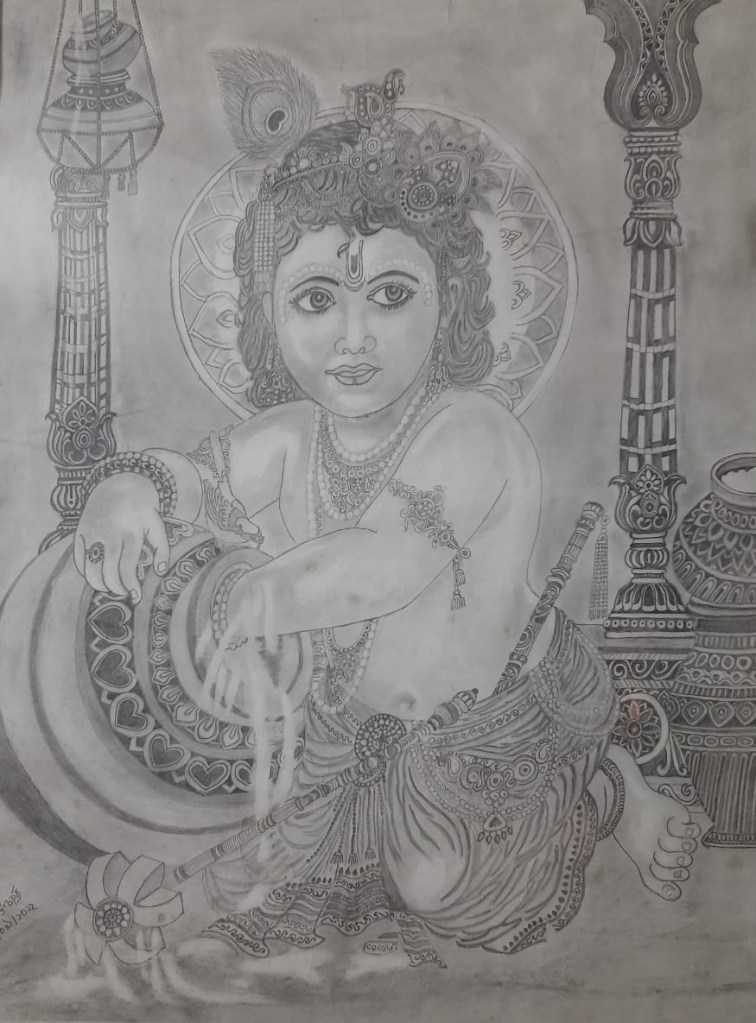
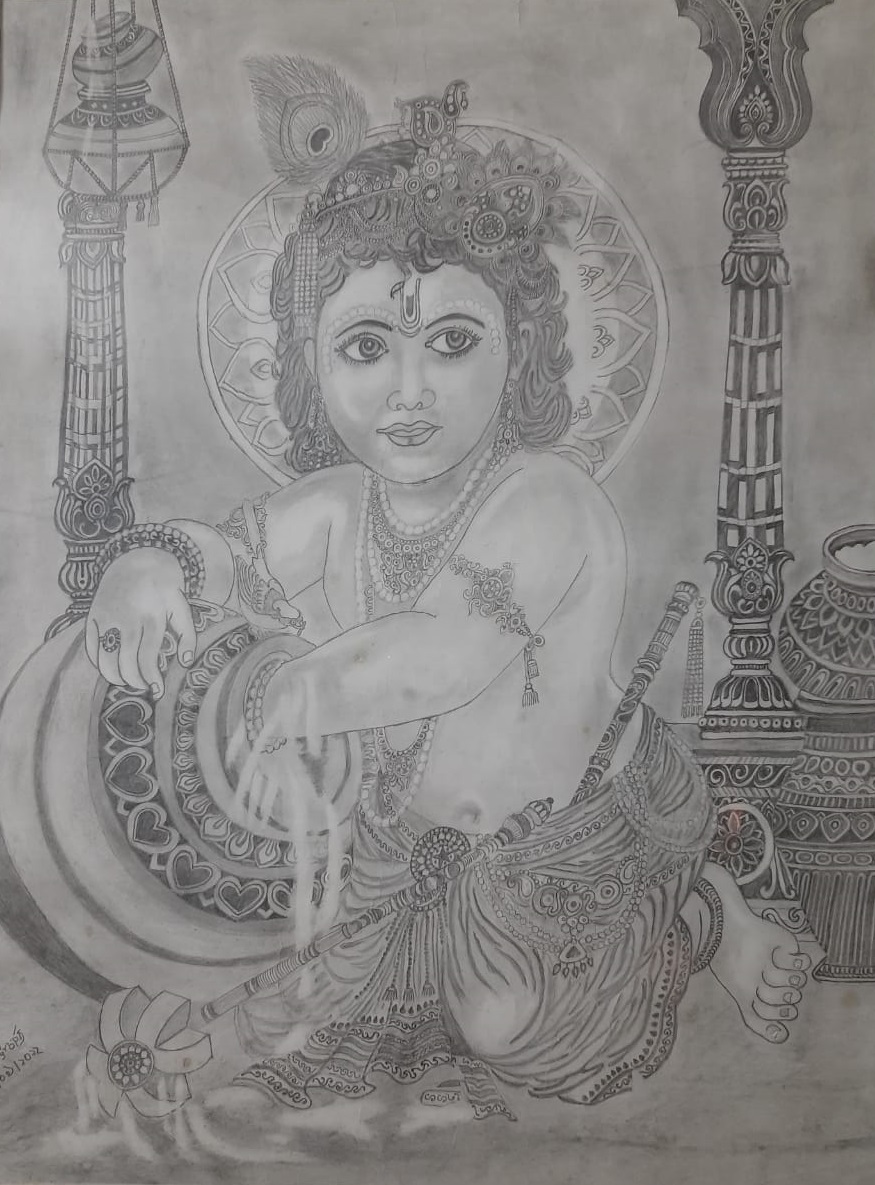
Gopal Sri Krishna – Sketched by Chanchal Chandra Bhattacharyya

Janmashtami is a major festival of the Hindus. It is celebrated all over the world to commemorate the birth of Lord Krishna, who was the eighth incarnation of Lord Vishnu, the principle God of the Hindus. Janmashtami is also known as ‘Gokulastami’ and is celebrated on the eighth day of Bhadrapada.
Krishna was the son of Vasudeva and Devaki. Vasudeva was the king of Yadav clan. Kansa, a tyrant, and the maternal uncle of Krishna was very cruel and along with other such cruel Demon kings, was terrorizing on the earth. Kansa was the brother of Devaki, who removed his father Ugrasen from the throne of Mathura, imprisoned him and occupied the throne.

Devaki, was married to Vasudeva as Kansa wanted to take over the control on Yadav destiny. After marriage when Kansa was escorting the newly married couple, Devaki, and Vasudeva to the kingdom of the Yadav, he heard an announcement made from the Heavens, that the eighth child of Devaki will end his life. Kansa on hearing the forecast became furious and plunged to de head Devaki with his sword. Vasudeva begged his wife’s life and assured that he will hand over every child soon after their birth. Hearing this promise, Kansa did not kill his sister but imprisoned the couple, so that he could smash each of their new-born child to death in the prison.

However, all the seven children of Devaki were killed by Kansa one by one. On birth of the eighth child the prison surprisingly started glowing with bright heavenly light and at the same time Vasudeva was woken with a divine voice and was advised to shift the child to the house of Nandaraja, the king of Gopa tribe (cowherds) and a bosom friend of Vasudeva.

All the guards of the prison were made fast asleep, the doors started opening one by one, as Vasudeva proceeded with the Divine child. The night was stormy, complimented with thunder and heavy rain. Vasudeva crossed the Yamuna river with the help of Sheshnag, the giant multi headed snake of Lord Vishnu.

Vasudeva reached the house of Nandaraja who was waiting for him. They entered the room where Yashoda the wife of Nandaraja was lying with her newly born girl child. Vasudeva kept his child beside Yashoda, in exchange of her girl child and returned back to the prison .Vasudeva narrated everything to Devaki .As soon as he handed over Nandaraja’s daughter to Devaki, the little one began to cry loudly . The cry woke the guards up and they immediately informed Kansa about the birth of the eighth one.

Kansa reached the prison sharply and snatched the child. Devaki prayed Kansa not to end the life of the child as the child was a female one and in no way, she could make any harm to Kansa. Kansa did not pay heed to her request and threw the baby to smash against the wall of the prison room. The child with a smile said, “I am Goddess Durga. I can destroy you instantly but will not do the same as your time of death has not yet come.” saying this she disappeared.
Child Krishna became the center of love in Gokul as he was loved and cared by all. His foster parents Nandaraja and Yashoda, and every villager and his friends loved him for his intelligence and courage. Krishna became the hero of all residents of Gokul as he was a sweet one.

In course of time he killed his maternal uncle and saved Mathura from the terrible rule of Kansa. The festival, Janmashtami is so named as lord Krishna was born on Ashtami (the eighth day of Bhadrapada) and he was the eighth child of his mother. Lord Krishna was the icon of love and bravery. Krishna Janmashtami is celebrated all over India mainly in north India especially In Mathura and Vrindavan. Krishna followers today are spread all over the world and they spread his message of love, courage, and purity of soul. On the great Janmashtami festival, the Krishna Temples across the world are decorated with colorful balloons, garlands, and festoons. The puja on Janmashtami starts at midnight as it is popularly known that Sri Krishna was born in mid night.

Devotees remain on fasting for the entire day. They offer laddu and other sweet items along with flowers, dresses, and ornaments as a part of their worship. On this day, Lord is generally worshipped in his baby form and his idol is placed on a cradle.

A special ‘Dahi Handi’ program is held as the lord was a lover of milk products, especially ‘makhana’ (butter). On the day of the festival, colorful pictures are displayed on the bravery and love of Lord Krishna.
To the Hindus and Vaishnavas, Lord Krishna is the icon of bravery. He is the closest friend and the savior God.
Hope you loved to know about Janmashtami and the story of the Lord and would like to know more about him.

To share your thoughts, please email us at contactareaderscorner@gmail.com