
Motivational · Mythological · Spiritual

Devi Bhairavi

Devi Bhairavi is the fifth great power of Das Mahavidya and is one of the supreme controllers of the eternal cosmic function of this universe.

Devi Bhairavi is a fierce and popular Goddess and is the Goddess of Decay. Bhairavi means ’Terrifying’. Mata Bhairavi is also known as Tripura Bhairavi and her consort is Bhairav the fierce form of Lord Siva. Devi Bhairavi is the supreme terror of the three worlds- Swarga, Martya, Patal. According to Parasurama’s ‘Kalpasutra’, the name Bhairavi is originated from the combination of three root words – ‘bha’,‘ra’ ,‘va’. In this ‘bha’ means preservation, ‘ra’ denotes Ramana means divine activities of creation, ‘va’ derived from Vamana means relaxation in certain activities.

Devi Bhairavi has many qualities like Goddess Kali. She is the Goddess of transformation, and the power connected to destruction of evil forces.

She is the goddess of destruction. Destruction here is not considered a negative force, but essential to maintain continuity in the great cycle of death and birth in the world. Mata Bhairavi is also popularly known as ‘Tripura Bhairavi’ where ‘tri ’means three, ‘pura’ means castles and cities. Hence Tripura Bhairavi indicates three levels of consciousness active-dream-sleep.

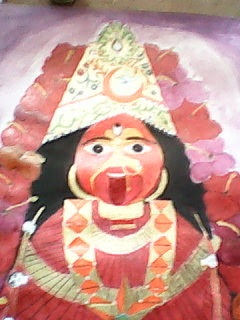
Mata Bhairavi in images and idols are found to be seated on a Lotus with four hands- with book in one hand, rosary bead in another, in another one Abhaya mudra and in the other hand displaying Varada mudra. She is wearing red clothes and a garland of severed heads on her neck. She has three eyes (Trinayan) and a crescent moon on her crown. In tantric form of the Devi, we find her sitting on Lord Siva, her one hand with a sword and a cup of blood in another one, her other two hands are with Abhaya and Varada mudras, respectively.

It is stated that Devi Tripura Bhairavi resides in Muladhar Chakra, and her mantra consists of three alphabets (letter) forming an inverted triangle in the centre of Muladhar chakra as ‘kamrupa’, representing the Universe. Devi Bhairavi is the creator of this Muladhar Chakra.

In Tantra, a female adept in Kundalini system is also known as Bhairavi, yogini. Sometimes she prefers to be with her Bhairav, the male partner, at the time of meditation and devotion, called yoga. In Tantra, Bhairavi has been defined as the divine queen closely associated with Devi Rajarajeswari or Tripura Sundari. Hope you loved reading. To share your thoughts, please email at contactareaderscorner@gmail.com
Motivational · Mythological · Spiritual · Stories

Devi Bhuvaneshwari

Devi Bhuvaneshwari Is the fourth Shakti form of the Das Mahavidya after Kali, Tara and Shodashi. She is also known as Adi Shakti Parvati or Parashakti.  Mahadev Tryambak is her consort. The name Bhuvaneshwari is originated of the two words Bhuvana (universe/world) and Ishwari (Goddess/Devi/ protector/Queen) that means Queen of the World or Queen of the Universe. She is the Mother of the Earth, the Atmosphere, and the Heavens.

Based on legend, all the three regions earth, atmosphere, and heavens, are created by Devi Bhuvaneshwari. After creation of world Maa Bhuvaneshwari made all the living creatures. She has given them eternal shape. To maintain and nourish her creations, she created Brahma, Vishnu, and Rudra. There after she distributed her energy and supreme power, and as Saraswati joined Brahma, as Laxmi partnered Vishnu, and as Kali partnered Rudra, These three devas were entitled the task to create, to sustain and protect, and to destroy respectively.

Brahma with the help of Devi Saraswati has created all living beings. Vishnu with Laxmi is engaged to sustain a portion of the creation and Rudra with Kali is in a process to annihilate other portion of the creation to maintain balance in the universe. Thus, there is a continuous cycle of birth and death.

Devi Bhuvaneshwari and Mahadev Bhuvaneshwar in images and idols are found seated on Panchapretashana where Sadashiva, Ishwar, Vishnu, Rudra, and Brahma are shown as five legs and several yoginis are seen busy in serving them.

Goddess Bhuvaneshwari controls this universe. She is the Almighty. She considers all the living beings as her children and protects them always. She loves each of her creation and is a part of every creature. She fulfils the desire of every individual coming to her refuge.

Devi Bhuvaneshwari is red complexioned and three eyed (Trinayan). She has four hands, has braided hair, and found wearing red ornaments. As weapon she holds a goad and a noose in left hands, in right hands she is with Abhaya and Baroda. She is ornamented with crescent moon on her head.

Please email at contactareaderscorner@gmail.com

Mythological · Spiritual

Goddess Tara, the second among the ten wisdom Goddesses (Das Mahavidya)

Goddess Tara of Tarapith
Goddess Tara of Tarapith, by Chanchal Chandra Bhattacharyya

In Hinduism Goddess Tara is the second deity of the Das Mahavidya , the ten great wisdom goddesses. They are the ten forms of Devi Mahamaya, the Mother of Universe. In our last post we spoke about the first deity Goddess Kali.

Maa Tara is Shakti (energy) and this feminine energy represents kindness. She is the Goddess of fulfilment and of liberation. The name Tara is derived from Sanskrit root ‘tr’ meaning to cross.

Maa Tara removes attachment from her devotees and help them to achieve what they want. She grants success. She strengthens inner qualities of ’karuna’ (compassions), metta (affection-charity), and sunyata (empty). She is worshipped by Hindus and Buddhists.

Goddess Tara is defined as protector of her every creation on earth. Tara means ‘saviour’, ‘brightness’ and ‘star’. She is also named as Tarini in Tantra Sastra. Goddess Tara is blue complexioned. She wears a tiger skin skirt, wears a garland made of severed human heads. She has four hands and a projected tongue. She is standing. Maa Tara has eight forms and are called ’Asta Tara’.

Tarapith, is a siddha pith located in Bengal, India. In Tarapith, the Goddess looks bright and majestic with a silver crown on her head, and a red vermilion on the parting of her beautiful hair. She is shown as the mother of Lord Siva in child form in Tarapith. She is the mother of all beings on earth.

In Tibetan Buddhism, Tara or Shayama Tara is also known as ‘Jetsun-Dolma’, a prime deity. In Mahayana Buddhism Tara is described as female Buddha. In Vajrayana Buddhism Devi Tara is known as the Mother of liberation and as deity of meditation (in Tibet). Goddess Tara is known as Mother of all Buddhists.

In Japan Devi Tara is known as ‘Tara Boatsu’.

Maa Tara destroys evils. She loves the blood of demons. On the other hand, she cares for all her children irrespective of religion and social status. Goddess Tara is the mother of all. She is the protector. She grants our wishes. Her blessing is always with us.

Jai Maa Tara

Hope you loved to read about Goddess Tara.

Email : contactareaderscorner@gmail.com

Mythological · Spiritual

Hindu Goddess Kali, Chief of all the ten Tantric Goddesses (Das Mahavidya)

Mata Kali is the principle deity among Das Mahavidya of Goddess Parvati. As Mahamaya (in the form of Sati), she could alarm the great Lord, Mahadeva Siva, her husband. When Devi Sati desired to go to her father’s house to see the Great Yajna arranged by him, she was not allowed by Siva. They were not invited as Prajapati Dakshya intended to insult them. Sati being furious, showed her originality in ten forms These ten forms of the divine mother are known as Das Mahavidya.

Kali is the initial form. She is Adi Devi. She is the destroyer of the evil forces. She protects all her innocent children, every living being on earth. She is known as ‘Shakti’ (strength) and the community who follows her is called ‘Shakta’.

Kali is worshiped by the Tantric Devotees as the divine Mother. She is worshipped by Hindus, Buddhists and the Tantric sects, and many others irrespective of their religion as the ultimate reality, Adi Shakti. She helps attain liberation, Moksha.

Kali is the feminine figurine of ‘Kal’, the eternal time. Kal or Mahakal, as she is described in Mahabharat, controls the universe. She is the supreme controller of life and death. She controls every event in this universe. Her companions are the spirits. She wears a chain of skulls. Goddess Kali has a dark blue complexion. In portraits and idols, she is found to be with Lord Siva.

We find the mention of Kali for the first time in Atharva veda. She is Trigunatit, or beyond the control of the nature and all levels of wisdom (Sattwa, Rajasik and Tamasik). In Mundak Upanishad Kali is not shown as a Goddess but as the dark blue tongue of the seven tongues of Agni, the fire God.

Ma Kali represents feminine quality and is called ‘Prakriti’ – the nature. According to the legends, she is the slayer of demons, the evils.

Let the blessings of Ma Kali protect every individual on this Earth.

To share your thoughts please email us at contactareaderscorner@gmail.com

Mythological · Spiritual

Das Mahavidya

Goddess Mahamaya, the creator of this Universe is beyond the cycle of death and birth. She is the mother of all the living beings. She rules and protects TrilokSwarga, Marta, and Patal. Devi Mahamaya has taken birth on earth several times at different era to destroy evils and save her creation. This fact was described by Sage Medhos to king Surath.

In Tantra Sastra it is stated that Goddess Mahamaya has revealed her ten forms of power, representing female energy in the form of Mother and creator to destroyer. The entity of strength and truth. Again, ten Mahavidya (great wisdom) are ten forms of Devi Mahamaya representing the ‘divine spiritual wisdom’ and showing the path of liberation.

In Chamunda Tantra, the names of the ten forms of the Devi (bolded) can be found in the following stotra:

Kali Tara Mahavidya Shodashi Bhubaneswari,
Bhairavi Chhinnamasta cha Vidya Dhumavati tatha.
Vagala Sidhdhavidya cha Matangi Kamalatmika
Ete Dus Mahavidya Sidhdhavidya Prakirtita.

The story depicting the origin of Das Mahavidya as per legend

Prajapati Dakshya, one of the descendants of Lord Brahma, wanted to get Devi Mahamaya as his daughter and began a strong tapasya. Devi gave her consent with a condition that She would leave Her earthly body and return to Her abode if anybody misbehaved with Her. Following this, Devi took birth as the daughter of the queen Prasuti wife of King Dakshya and was named Sati. Sati married Lord Siva against the wishes of her father Dakshya, which made her father very angry. Prajapati Dakshya performed a great yajna. With an intension to insult Lord Siva, he invited all the Gods and Goddesses except Siva.

Lord Siva was aware of the event but ignored to maintain peace. However, knowing that her father is performing Yajna, Sati desired to visit the event and see her parents. She sought permission from her husband, Lord Siva, who denied granting her permission to meet her father and explained Dakshya’s prime intension. Lord Siva in turn, warned Devi Sati that she might get insulted there following which her father might be in danger. Sati became very furious at this and thought that Siva considered her an innocent lady and was not aware of the fact that she was an incarnation of the Mother of the universe. She was so angry that she wanted to teach her husband a good lesson by showing her original form of strength and eternity. She took the form of the Divine Mother, Devi Mahamaya.

Seeing the violent, strong, and immensely bright Divine Motherly aura of her original form, the nature started behaving unnaturally. The rivers, lakes and oceans became turbulent responding to violent thunder, storm, and heavy rain. It was dark everywhere unnaturally mixed with a fiery red light. Lord Siva was scared to see her and wanted to flee from her but found himself guarded on all ten sides by the ten forms of the Goddess. These ten forms are popularly recognized as ‘Das Mahavidya’.

When Sati met her parents on the day of the Yajna, she was welcomed by her mother but was insulted by her father. Her father used filthy words to insult her and Lord Siva. She could not tolerate this misconduct and left her mortal body, simply to say she lost her life.

Lord Siva through his third eye when saw the incident was furious. He created the strong Veerbhadra out of his own hair and sent him to Dakshya’s yajna bhumi with the task of killing Dakshya. Veerbhadra and the army of Lord Siva killed Dakshya and ransacked the yajna bhumi, and the palace.

Lord Siva started his ‘Tandab’ dance with Sati on one of his shoulders, as he took the form of the destroyer. Everyone was scared. The nature lost its balance. To calm Siva down, Lord Visnu used his famous Sudarshan Chakra and cut the lifeless body of Devi Sati into pieces which got grounded at different places. These places later came to be known as Sati pitha.

At present Das Mahavidya are worshipped among the Hindus. The 51 Sati pitha spread across different places of India and Nepal primarily are the auspicious places where the Devi is worshipped in different forms by Hindus and Buddhists.

I will speak in detail about the Das Mahavidya and about all Sati pitha in my future blogs.

Hope you liked to know the origin of Das Mahavidya.

To contact with us please email at contactareaderscorner@gmail.com

Motivational · Spiritual

Benefits of Pranayama

What is Pranayama?

Pranayama may be simply defined as breathing exercise. It includes three prominent steps- inhalation, retention, and exhalation.

Types of Pranayama

There are several types of Pranayama. Today I have planned not to go deep into explaining each one of them but to just name a few of them for reference and to give you an overall idea of the importance of Pranayama. I have a plan to focus more on each of the Pranayama processes and their individual benefits in my future blog.

Let me mention the names of some common types of Pranayama.

  • Bhastrica
  • Kapalbhati
  • Nadi shodhana
  • Bhramari
  • Sheetali
  • Ujjayi

Why is doing pranayama so important?

Pranayama helps regulate the breathing process methodically. Pranayama is as important as doing Asana and Meditations in yoga. Let me sum up a few points by which Pranayama can help you.

  • Reduces high blood pressure
  • Reduces Cardiological problems
  • Maintains body temperature
  • Treats depression
  • Helps detoxification and help fight pollutions and germs
  • Helps to lose weight
  • Clears nasal passage and helps fight sinusitis
  • Improves mental conditions
  • Good for skin
  • Helps to sleep better
  • Improves Lungs function
  • Improves digestive system
  • Helps reduce bad cholesterol in blood
  • Controls mind and takes care of mental health
  • Helps you to remain alert and focus better in work
  • Boosts your immune system

In some research work it revealed that pranayama is a very effective way to improve physical as well mental health and promotes a better life. It helps to achieve result within a short period. Now a days it is very essential to do pranayama, as physical and mental stress is very common among all irrespective of their status in the society.  

Understanding the benefits of Pranayama is very important to get motivated and to seriously start practicing it to enjoy the wide range of benefits you get.

If you feel practicing Pranayama has helped you or might help you in future, do share your thoughts. Our future blog will have each of the types of Pranayama explained in detail.

Till then stay connected.

Email us at contactareaderscorner@gmail.com

Mythological

Mandhata or Mandhatri – the King of the Ikshvaku dynasty

Have you ever heard people saying “made at the time of Mandhata” about a very old item? Who or what Mandhata was? Let me tell you that he was a powerful king found mentioned in Hindu epic Ramayana, who ruled the world long ago.

In Satya Yuga, with the onset of human civilization, in there was a king named Yuvanshva who ruled the kingdom of Ayodha. He was a ruler of Sun-Ikshvaku Dynasty. Yuvanshva had no kids, hence no heir to his throne. He was perturbed.

One day while he was hunting in the forest in afternoon, he became very tired and extreme thirsty. As he was exhausted, he was in search of water. After a long search, the king noticed a hermitage of some sage. King Yuvanshva entered the hermitage which was empty. There, he noticed a pot and to his great pleasure the pot was full of water. The King was so thirsty that he began to drink the water without any hesitation. As soon as he finished drinking the entire water, the great sage Vrigu entered the hermitage along with his disciples.

Vrigu was startled to see the King there and wanted to know the reason of his visiting the hermit. The King narrated the backdrop. After listening to the king carefully, Vrigu told the water kept in the pot was enchanted, just to hand over the same to his wife Matinara so that she could give birth to a child. However, as destiny made king drink the enchanted water, the king would give birth to a son.

In course of time and to the utter surprise of all, king became pregnant. With the help of Sages and God Indra, the baby boy was delivered by cutting the left side of king’s abdomen. As the king was not able to breastfeed the boy, Lord Indra arranged divine milk from heaven. Drinking that divine milk, the baby became very healthy and strong. Within twelve days of his birth he became adult. He was named Mandhata or Mandhatri. He learnt Veda and war technics in a short while.

Mandhata had divine power and could acquire an impenetrable armour, a quiver with a boundless supply of arrows and a bow named ‘Azagava, which originally belonged to Lord Siva. He became so full of strength that he also fought with Ravana and the latter being defeated by him begged apologies and made treaty with him. Mandhata conquered the entire Earth within one day. He also conquered Patallok (Hell) and almost half of the Swargalok (Heaven). He defeated kings namely Asita, Suna, Sudhanwan, Marutta, Brihadhrata, Janmejaye and many others.

He had immense will power and could control the natural phenomenon like rain, hail, thunder, and storm. He was pious and distributed alms to the Brahmins. His kingdom was full of riches. He waived taxes from his subjects.

Mandhata married the daughter of Shashabindu, king of Yadavas. They had three sons and fifty daughters. In his reign, King Mandhata performed hundred Ashwamedha Yagnas and a hundred Rajasuya Yagnas. Susandhi the eldest son of Mandhata succeeded him. Susandhi the eldest son of Mandhata succeeded him.

At the old age Mandhata, due to his continuous success, became very proud of his success and strength and intended to capture the entire Swargalok. Indra, the King of Swargalok, was worried and played a trick. He convinced Mandhata to attack the kingdom of Lavanasur, a demon who had a special trident, which was gifted to his father by Lord Siva. He and his soldiers were defeated and were turned into ash by Lavanasur. Later, Shatrughna, a descendent of Mandhata killed Lavanasur.

I am sure, you loved to know about Mandhata. Please let us know your interests and do share your thoughts.
Email us at contactareaderscorner@gmail.com

Spiritual

A brief introduction to the Upanishads

Veda is ‘knowledge’ and was originally known as ‘Shruti’ as the sages passed on their knowledge verbally to the disciples and there were no written scripts. The conclusive part of Veda are the Upanishads. They are also known as Vedanta. Veda consists of two parts, one being the Karma Kanda (ritual or action) and the other the Jnana Kanda (knowledge).

Brahmanas, Aranyakas and Upanishads are branches of Samhita.

Upanishads discuss about knowledge and philosophical concepts. It is taught at the end of the Vedas as it speaks about the ultimate knowledge, the Moksha or enlightenment. Upanishad is derived from the Sanskrit root words Upa and Ni. Upa means ‘nearness’ and Ni denote ‘totality’. Hence, Upanishad means sitting closely with the Guru or teacher to get the complete supreme knowledge or Brahmavidya from him.

What is World? Who am I? What is after death? These questions have been discussed and answered in Upanishad. Its prime theme is nature and God. The doctrine of the true knowledge of nature and the concept of one God are the ultimate philosophies behind Upanishad.

There are four Vedas which are as below

  • Rig veda
  • Sam veda
  • Yajur veda
  • Atharva veda

Upanishads are associated with four Vedas and clarified their visions elaborately.

There are large number of Upanishads (almost 200) and mostly 13 of them, included in the four vedas are as follows:

  • Aitareya Upanishad
  • Isha Upanishad
  • Maitri Upanishad
  • Chandogya Upanishad
  • Kena Upanishad
  • Mundaka Upanishad
  • Mandukya Upanishad
  • Kaushitaki Upanishad
  • Brihadyaranyak Upanishad
  • Taittiriya Upanishad
  • Svetasvatara Upanishad
  • Katha Upanishad
  • Prashna Upanishad

Though the philosophy of all of them are same yet each Upanishad has its own original thinking and specific ways of enquiry. The Vedic sages gave the solution to source of Life and Liberation. According to the Upanishads, Atman and Brahman when connected through following the Supreme power, gives the path to liberation or moksha. Upanishads were considered the secret teachings. Gayatri Mantra from the Vedas found importance in relation to meditation and prayers. Upanishad plays a prime role in the evolution of the concepts of Indian philosophy.

It is difficult to understand the Indian Sanatan Dharma and the rich Indian culture without an intense knowledge of the Vedas and the Upanishads.

Hope you loved reading. I will try to share more concepts on the Upanishads in future.
Please let us know if you want to share your thoughts.
Email at: contactareaderscorner@gmail.com
Stay in touch.

Namaste.

Spiritual

Sanatan Dharma explained through Bhagwat Gita

Are you a truth seeker?

Do you want to know what Sanatan Dharma is and how it evolved?

Sanatan Dharma is the oldest religion on earth, and all other religions which are prevailing now, are converted form of the same. It believes in worshiping icons (Pratima). Principle deities were Indra, Surya (Sun), Varun, Religion based on Veda was formulated by God Narayana who created Brahma. Brahma is said to be the Father of this universe. After formulation of Veda, that was first narrated to Surya and Surya told it to his son Manu and Manu made all these living beings. According to this religion, puja, prayer, yagna, were made to Agni, Varun, Indra, seeking personal gain like Son, Wealth, Kingdom, Victory, heaven and so on.

It was about five thousand years back, Lord Vasudeva Krishna explained Bhagwat Gita to his devotees and intimate friend Arjuna In the Great War field of Kurukshetra of Mahabharata. When Arjuna, the third Pandava gave up his weapons expressing his denial to war with relatives, friends, for the sake  of kingdom, Sri Krishna told it was his duty to fight against the Kaurava to establish religion-based kingdom, which is a must for one kshatriya otherwise he will deviate from his duty, which is unfair.

Krishna further said on the Kurukshetra battlefield to Arjuna, “If you do your duty properly you will deserve to settle in Heaven without having further birth. You must do your duty without seeking any personal gain. Remember in this war you are not killing any one as these all are pre-settled. Man is mortal, ours on earth is merely old body. After death there will be rebirth of this body having a new formation, and the soul with the body is immortal and it cannot be destroyed. Hence, none can kill the soul. As there is no birth and death of the soul, it exists till it returns to Almighty God. Look at me, I am the Almighty God, creator of each and everything in this Universe… I have no birth no death. I have already decided the fate of this war and all the persons who ought to die in this war, I have already killed them.

Those who work with no expectation, in the name of God, giving the result to God, and not for personal gain and for others only, he is my actual devotee. I will protect him from all the adverse results. After death he will get no further birth.”

Arjuna was satisfied with the advice and prepared to war with Kaurava.

Lord Krishna in this way opposed the concept of Veda in worshiping for personal gain/expectations. In Bhagwat Gita he advised to do work without any expectation and encouraged to work in the name of God.

The name of Hinduism started in early nineteenth century.